Castles of North Wales: Edward I's Fortresses and the Welsh Princes' Strongholds
Published 23 September 2026by Petrunorth-walesheritage
Wales has more castles per square mile than anywhere else in the world.
Wales is often described as having more castles per square mile than anywhere else in the world, and Cadw puts the total at more than 600. Whatever the exact count, it tells you something about the ground you are walking on when you visit North Wales. These were not decorative buildings. They were built by people who needed them.
Two kinds of castle, two kinds of story
Broadly, the castles of North Wales fall into two groups: the great fortresses built by Edward I after his conquest of Gwynedd, and the castles built by the Welsh princes themselves.
The Welsh were not simply victims of castle-building. They learned fast. The earliest castles raised by Welsh rulers followed the Norman pattern of earth and timber. From the early thirteenth century, under Llywelyn the Great and his successors, the princes of Gwynedd began building in stone, and their castles took on a character of their own.
The Edwardian fortresses: the UNESCO four
Caernarfon, Conwy, Harlech and Beaumaris, together with the town walls of Caernarfon and Conwy, make up the Castles and Town Walls of King Edward in Gwynedd World Heritage Site, inscribed by UNESCO in 1986. Each one is a different answer to the same military problem.
Caernarfon is the one that stops people. Work began in 1283, and more than 700 years later its banded stone walls and polygonal towers still dominate the Menai Strait. It was a castle born out of war with the Welsh princes, and it was built to be seen.
Edward's castles came with new English towns. Walled boroughs were laid out beside the castles at Caernarfon and Conwy, and at Flint, and a walled town also grew up at Denbigh, where the castle was built by Henry de Lacy, one of Edward's leading lords. This was more than castle-building. It was the planting of an English urban order on Welsh territory.
Harlech sits high on a rock above the coast, looking out towards Eryri and the Llŷn Peninsula. It was built in the 1280s, and in 1404 it fell to Owain Glyndŵr, who held it for several years.
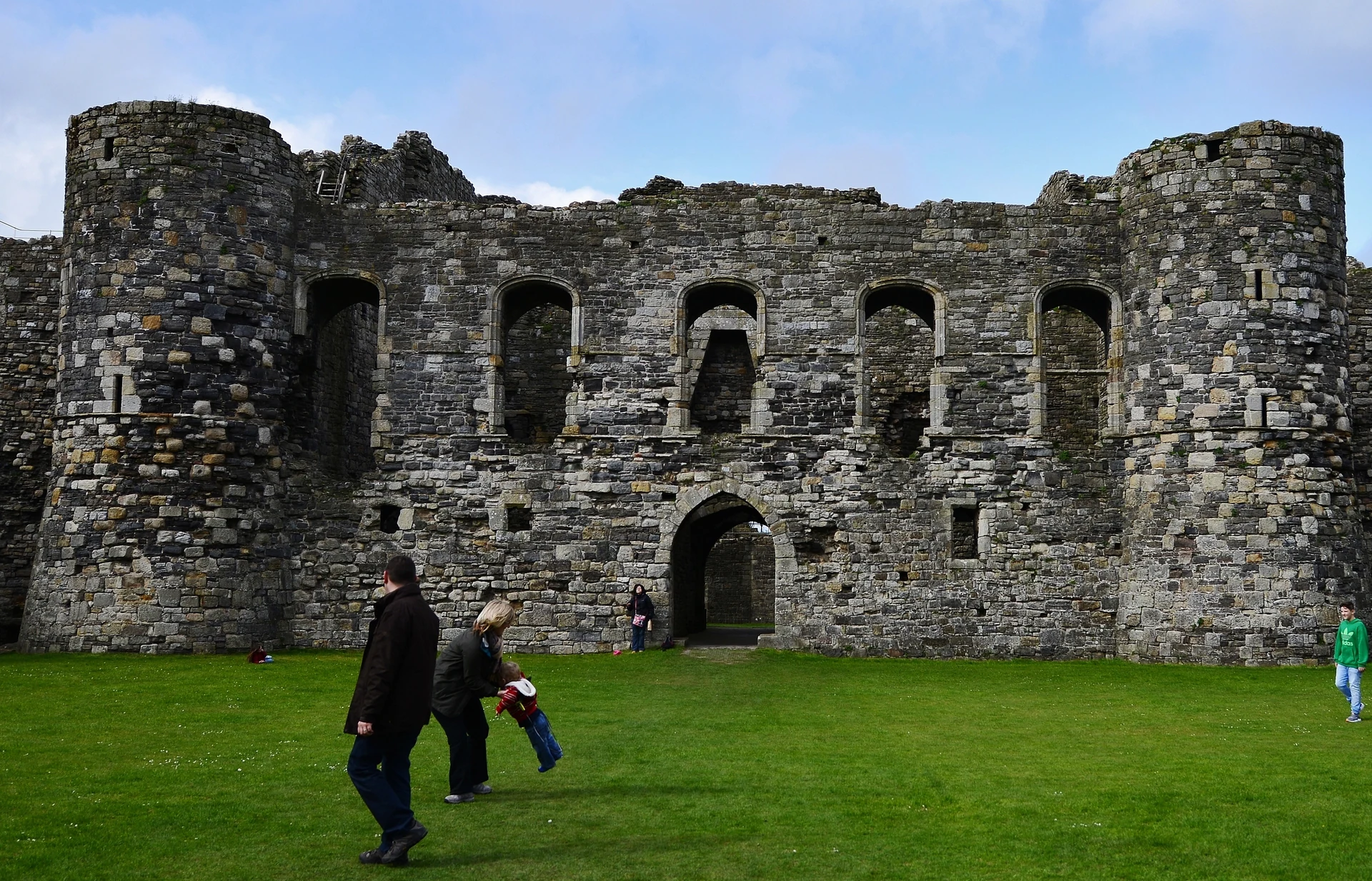
Beaumaris, on Anglesey, was the last of Edward's great castles in Wales. Work began in 1295, but money ran out and building had petered out by the 1320s, so the castle was never finished.
The castles the Welsh princes built
Llywelyn ab Iorwerth, known as Llywelyn the Great, left his mark on more of North Wales than most people realise. At Criccieth, he built the inner castle with its twin-towered gatehouse in the 1230s. The castle's visitor centre tells the story of the Princes of Gwynedd.
At Castell Ewloe in Flintshire, Llywelyn the Great probably built the D-shaped stone tower some time after 1210. Llywelyn ap Gruffudd, known as Llywelyn the Last, added the curtain walls and round western tower around 60 years later. Unusually, Ewloe sits low in a wooded valley rather than on a commanding height, and today it is reached on foot through Wepre Park.
Dolwyddelan stands on a rocky ridge among the mountains of Eryri. It is linked to Llywelyn the Great and shows how the Welsh princes guarded the routes through their own heartland.
Dolbadarn overlooks Llyn Padarn at Llanberis. Its round tower was most likely built by Llywelyn the Great, and the castle is free to visit.
Castell y Bere, in the Dysynni Valley in southern Gwynedd, was begun by Llywelyn the Great in 1221. Its long, narrow layout follows the line of the rocky outcrop it sits on, and it is another free site.
These native castles tell the other side of the story. That is the part most visitors miss, because the Edwardian fortresses are louder.
Chirk and Penrhyn: the castles that became houses
Not every castle stayed a castle. Chirk Castle, in Wrexham county borough, was completed around 1310 by Roger Mortimer as one of the border fortresses of Edward's conquest. It stands above the Ceiriog Valley, near where the Ceiriog meets the Dee. After the Myddelton family bought it in 1595, it was gradually turned into a grand family home, and the family lived there until 2004. Today it is cared for by the National Trust, with gardens and estate walks to explore.
Penrhyn Castle near Bangor is different again. It was built between 1820 and 1837 to designs by Thomas Hopper, in a neo-Norman style. It is not medieval at all, despite looking it, and behind its fortress front is a lavishly decorated interior. It is also cared for by the National Trust, which notes that Penrhyn was a filming location for the Netflix drama House of Guinness.
Flint and the Glyndŵr years
Flint, begun in 1277, was one of the first castles of Edward's Welsh campaigns. Cadw describes it as unique in design: its great round tower, or donjon, stands apart from the rest of the castle, separated by its own moat.
The story of these fortresses did not end with the conquest. During the rising of Owain Glyndŵr in the early 1400s, several came under attack. Conwy was seized by Welsh rebels on 1 April 1401, Caernarfon was attacked later that year, and Harlech was captured in 1404.
What you can visit today
At Conwy you can climb the spiral staircases in the great towers, walk the battlements and see what Cadw calls the most intact set of medieval royal apartments in Wales. Caernarfon, Conwy, Harlech and Beaumaris are all run by Cadw and charge admission, while smaller sites such as Dolbadarn, Castell y Bere and Ewloe are free. Chirk and Penrhyn are run by the National Trust.